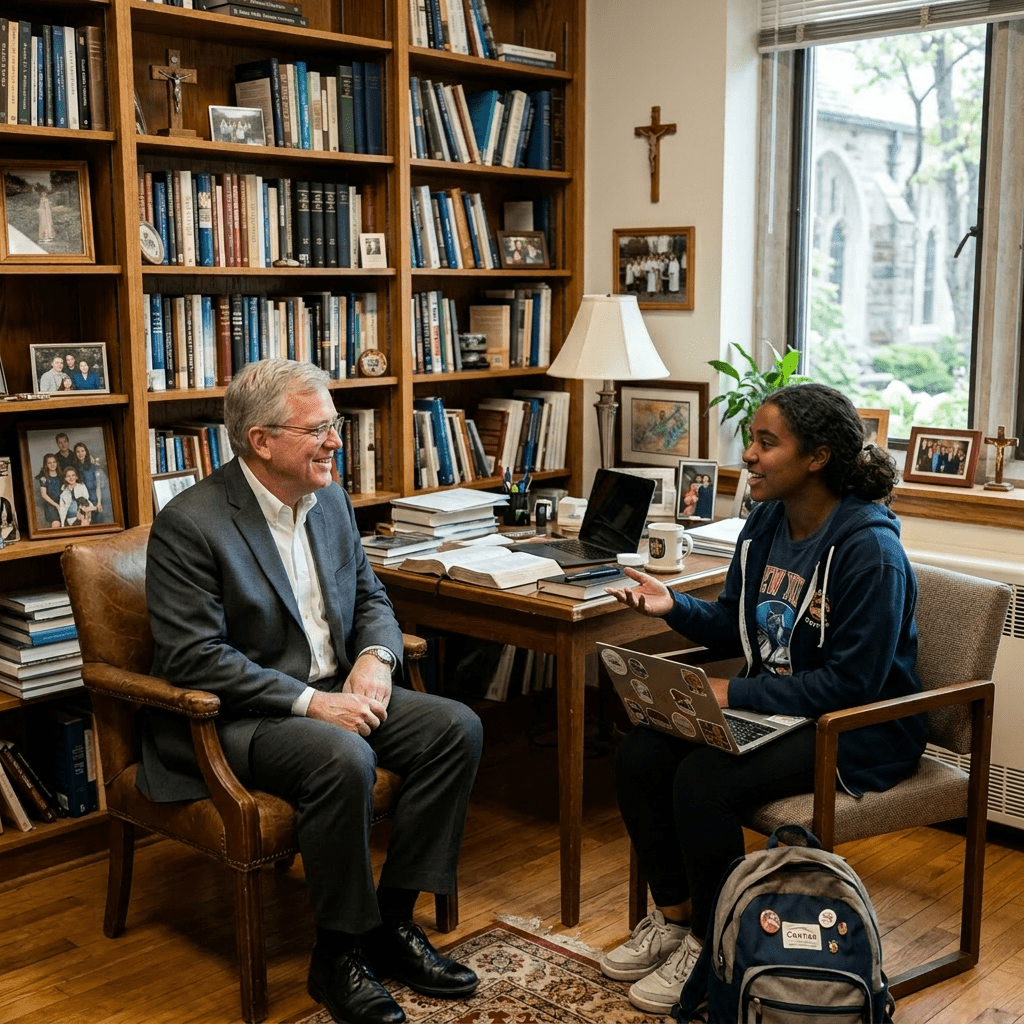
The first time I saw Dr. Joe Neal McKeever, he was sketching two young women. At the time, he held the position of Director of Missions for the Baptist Association of Greater New Orleans. Joe (he insisted I call him “Joe”) graciously consented to contributed his blog articles to my faith blog. I made a mental note to contact Joe and request permission to write about his ministry. The note hung on the corkboard in my mind for months, maybe longer, before I stumbled across him on Facebook. Three months later, I found time to buy him a hot chocolate at Café du Monde. He arrived with a sketchbook in hand.
Joe entered the world in 1940 near Nauvoo, Alabama. As far back as he could remember, church had been a part of his life. His first six years revolved around activities at the New Oak Grove Free Will Baptist Church.
His father moved the family to the mountainous coal fields of West Virginia when Joe was seven years old, and they joined a Methodist church. “The church was wonderful,” said Joe, “a great place for a child. I loved the Lord, loved the church, and loved the pastor.”
The following year, Joe sat next to his mother when the pastor gave an altar call for salvation. Joe looked up at his mother. “Can I go to the altar?” She nodded her approval. He slipped out of his seat and walked to the front of the church. The pastor shook Joe’s hand and instructed him to kneel while he waited for others to join them. Several children joined Joe at the altar before the pastor instructed them to stand and introduced them as new converts.
Joe smiled. “The following Sunday, they gave us grape juice and crackers for our first communion, but no one explained anything to us. We were ‘in,’ but nothing changed in my life.”
Three years later, Joe’s family returned to Alabama and the New Oak Grove Free Will Baptist Church. When Joe was eleven years old, an evangelist came to the church for a two‑week revival. Thoroughly convinced of Jesus’ soon return, the evangelist declared he would still be driving his 1948 Pontiac when Jesus came back.
“I wonder if he’s still driving that car,” Joe laughed. “When he gave the altar call, I had an overwhelming sense of guilt and a burden about my condition. In those days, congregation members followed you to the altar. By the time I reached the altar, there were eight people with me. I didn’t know how to pray, so I just knelt and cried. I still remember my aunt whispering in my ear, ‘You never were a bad boy, Joe Neal, you just weren’t saved.’ I don’t think I said anything to God, but I knew something had changed. I walked back to my seat with an overwhelming sense of love for everyone in the church.”
Joe graduated from high school, intending to become a college history professor. While pursuing his dream at Berry College, his sister called requesting his help while her husband was away on business. Joe transferred to Birmingham‑Southern College so he could live with his sister. He couldn’t find a Free Will Baptist Church in the city, but there was a large Southern Baptist church about a mile from the college.
“I just knew I would not like West End Baptist,” said Joe. “I thought all big‑city churches were cold, dead, worldly, and formal. I was wrong. The church was wonderful.”
Even though the young adults at the church had grown up together, they received Joe as though he had always been a part of their group. He blossomed like a potted plant taken out of a dark corner and placed in the sunlight.
Joe rested his chin on his hand and looked thoughtful. “I knew I was called to ministry in April 1961. I was singing in the church choir on a Tuesday night. Suddenly, I felt a curtain had opened, and I heard the Lord say, ‘I want you in the ministry.’ It wasn’t an audible voice; it was much stronger than that.”
Joe faced one of the greatest challenges in his ministry at a church in the Mississippi Delta. During the height of the Civil Rights Movement, he preached God’s love for all races. He was unaware of his congregation’s struggle with his bold declaration until the chairman of the deacons approached him.
“What you are preaching is correct,” said the chairman, “but I want to remind you that the pastor who preceded you taught these people that segregation was God’s way. You can change them, but you need to be patient.”
Joe placed an ad in the local paper announcing “Visitors Sunday.” His congregation was preparing packets to give visitors when they learned an integrated civil rights group planned to attend the church.
“That would have been lovely for me,” said Joe, “but some of the church members would have gone ballistic. The rumor mill went into overdrive, and I cried out to the Lord for help.”
God spared Joe the task of pacifying angry church members when the integrated group failed to appear, but the Lord honored his patience and prayers. A detective on the local police force shared Joe’s burden for reaching young people with the gospel. They organized a Delta‑wide crusade. Sixty churches participated in the December 1969 crusade held at a local high school. During the week, 3,500 young people filled the stadium, with 5,000 in attendance on Sundays. The evangelist who spoke said it was the most integrated meeting he had ever attended.
Joe accepted a new pastorate in Columbus, Mississippi, in 1974. The people were more progressive than his last congregation. Even though the civil rights movement had calmed by the mid‑70s, churches were still splitting over integration. Several black students from Mississippi State University attended but had never joined the church.
During a deacons’ meeting, one deacon asked the chairman, “What are we going to do if one of the blacks joins the church?”
The wise chairman said, “Don’t worry about it. Pastor has a plan.”
Joe laughed. “My plan was to receive them, but I knew that’s not what they had in mind.”
The following year, Kezia Chogo approached Joe. “Dr. McKeever, I believe the Lord would have me join the church.” Joe knew accepting Kezia as a member could tear his church apart, so he stalled for time. He assured her it would be wonderful to have her as a member. He gave her a book on Baptist beliefs and instructed her to mark anything she had a question about. “Kezia already knew what Baptists believed,” said Joe. “I needed time to enlist people to pray.”
When Kezia finished reading the book, Joe spoke frankly and honestly. “Some members might object and say rude things when I present you for membership, but I have a plan.”
Since Baptist missionaries had led Kezia to the Lord, Joe was confident his missionary-minded church members would not reject the fruit of their labor. Kezia understood her pastor’s predicament and agreed to give her testimony when he presented her for membership.
The rest of the week, Joe prayed earnestly for wisdom. On Sunday morning, he presented Kezia for membership. As planned, she shared her testimony with the congregation. Joe watched the faces of his members as she spoke. When he asked for a motion to receive her into the church, a deacon stood and said, “Pastor, I make the motion that we receive this young lady. She is the fruit of our missionary work.”
Another deacon quickly seconded the motion. The congregation voted unanimously to receive Kezia as a member. Joe breathed a sigh of relief. “The Lord honored our prayers,” he said. “It was a turning point for our church.”
Joe continued to serve faithfully, trusting God to guide him through every challenge. Over the years, he pastored churches in Mississippi, Louisiana, and beyond. His ministry touched thousands through preaching, teaching, sketching, and writing. His gentle humor, deep compassion, and unwavering commitment to Christ made him a beloved figure in every congregation he served.
As we finished our hot chocolate at Café du Monde, Joe leaned back and smiled. “If there’s one thing I’ve learned,” he said, “it’s that God’s timing is perfect. We get into trouble when we try to rush Him. But if we wait on the Lord, He always comes through—always.”

Leave a Reply